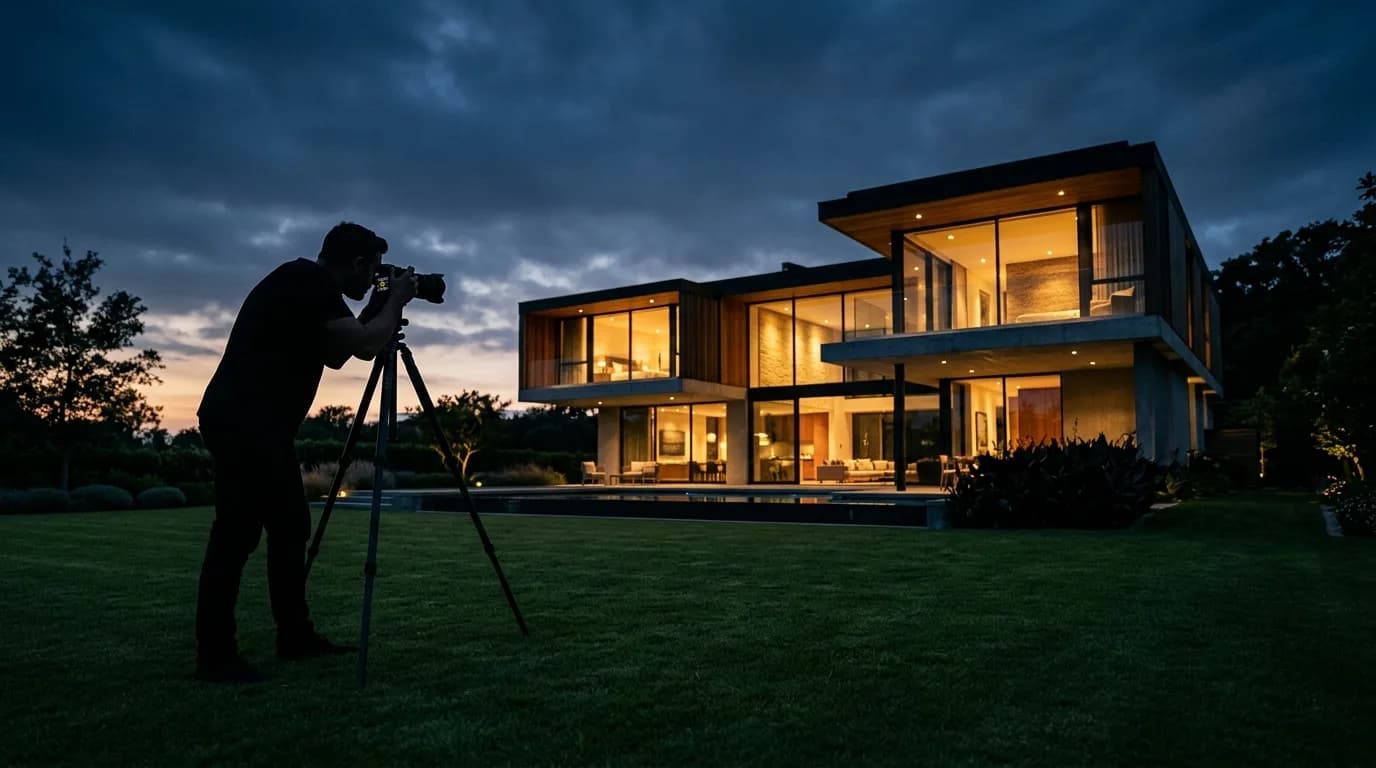
Ask an agency owner about their team and you get an honest answer about the top of it. The first two or three creatives are excellent. They handle a difficult agent gracefully, and nobody ever had to tell them how to represent the brand. Then the curve gets steep. By person eighteen someone forgets their Zillow camera at home, and the standard you spent years building is defended by you personally, one shoot at a time.
That is the real ceiling in this business, and hiring is not where it breaks. The agencies that get past it run a program that turns someone with a camera background and no real estate experience into a confident shooter on the house workflow in about sixty days. Their photographers are no better than yours on the day they start.
Hire for what you can train
The ideal candidate for a sixty day program is someone comfortable with a camera and a gimbal who has never shot a house. The experienced real estate photographer is the harder hire, because there are many defensible ways to shoot a house and it is hard to teach an old dog new tricks. If you are standardizing, you want one way through your business, not four imported ones you spend a year sanding down.
That pushes the screen away from portfolios and toward character. One agency owner in the session listed what she looks for before any creative conversation happens: humility, gratitude, whether they honor the client, whether they can read a room, whether they find solutions. She has trained every person on her team.
Well, of course talent, you know, will get you through the door, but I say character will keep you at the table.
Two years on, the coaches in the group are saying the same thing with more scar tissue.
You have to find someone who's a salesman person who's good around clients who you can trust. And you could go on vacation and know they're not going to get you a bad rap. They're smart enough to follow instructions that you've put in front of them and they're smart enough to be taught how to shoot the way you shoot most of the time. We go find out someone who's a killer shooter and we think we can cram those other two things, the personality and being able to follow instructions into them. And we find that it doesn't really work.
His screen on a stack of applications is a video: "if they don't have videos, I won't watch them."
One role has fallen off the hiring list since the 2024 workshop: the photo editor with real estate experience. One agency's monthly editing bill went from $12,000, some months $20,000, to a flat $3,000 when it switched. Another owner in the group went from 85 cents an image with human editors to 43 cents for daytime work.
Now we don't need the person with experience that can edit the photo. They're basically obsolete because auto HDR is doing it for us already.
What you hire instead is someone who can tell when what comes back is wrong, and judgment is what the next two sections train.
One warning sign shows up after the interview: friction. The candidate who says all the right things but keeps producing small obstacles, still finishing another job, cannot make the gear pickup, has plans, is telling you something. Do not push through it.
Teach one workflow, hands on, and let it copy itself
Hands-on training beats video courses, because sitting beside someone you see in real time what they are struggling with. The obvious objection is that it does not scale.
You would think that's not scalable. Like, how can you train everyone on your team? Well, it is, because once you train one guy good enough, eventually he'll be able to train the next guy. So it's kind of the machine that builds a machine.
That compounding is visible inside one of these agencies. One creative lead personally trained eight creative specialists, and another helped train roughly fifteen more. The video lead trained between ten and twenty editors over five years. Almost nobody there was trained by the founder.
The founder's part can be as small as one day. Here is how the coach above ran it at his own agency.
They only met with me as the owner on day one. I issued them all their gear. I made sure they understood how to, like, balance their, you know, gimbal, all that stuff. I showed them how to shoot a house, and then they were off for that day. The next day they came back. They were with my lead. They followed him, they watched him.
By the second house on the second day the new shooter was starting rooms on their own and being corrected by the lead. His warning was not to let a new hire follow you around for 40 hours, because it wastes both of you. Concentrate the teaching, then hand them to the lead.
What the lead teaches has to exist on paper first. Don, who hosts the ACRE Process Labs, ran a session in August on exactly this, and his test for whether something needs documenting is simple: "If you keep answering the same question, you probably need a process." His format is six lines: purpose, trigger, who owns it, steps, exceptions, and what done looks like. His warning: "A 47 page SOP nobody reads isn't helping anybody."
What gets standardized is the craft, not just the schedule. Flash photography first: one speed light on top of the camera, roughly eighty dollars on Amazon, gets you seventy or eighty percent of the way without full flambient work or the editing cost attached to it. A shift lens gets you straight verticals in camera. Then HDR video, HLG or PQ, for reels and luxury listings, because the phones people watch on already support it.
Then the part most programs skip: teaching the shooter to read the client, so a first-year agent is not pitched a $3,000 to $4,000 cinematic production and an older agent with no social presence is not sold an Instagram reel. That judgment is trainable.
Finally, let your creatives talk to clients. Not to sell, just to call on the way and introduce themselves. Owners resist this, and it is what has to change for clients to trust the brand rather than you.
Put quality in a loop instead of in your inbox
A training program without a feedback mechanism decays back to whatever each person prefers within a few months. Two things hold it in place. The first is connecting editing to shooting, so the person who sees the mistake talks to the person who made it. The second is a defined channel for misses: missed uploads, missing photos, and quality problems route through project management, which feeds them back to the shooters and editors. A KPI, not a conversation you have when you happen to notice.
The loop costs less than most owners assume. Corey Dostal of Kiln Media pays an outsourced team about $550 a month to quality-check everything before it goes out. At Don's agency the QC seat has one rule, photos out by 8pm, backed by a second one: shooters upload by 7pm or tell the office they will be late. A new client's first order gets rushed on purpose while the promise on paper stays at same day, so the surprise works once and the expectation holds.
How long the human check lasts is an open question. Brendan's view at the September roundtable was that "you probably don't even need QC in a year," which makes it a temp seat rather than a career. Jacob Rokusek's version is that the AI can edit and mostly check the photos, "but we still need hands on there" for the exceptions.
Standards apply to the boring things too.
The calendar is sacred at our company at Aerial Canvas. If it's on your calendar, that's what the expectation is. If your calendar is open, you're available. If you're not available, provide notice.
Pay for the standard you are asking for
Training holds only if the economics behind it hold. The coached budget:
| Bucket | Target share of revenue |
|---|---|
| Cost of goods: shooting plus editing, as one unit | Under 50% |
| Sales, marketing, operations, software, insurance, accounting, taxes | 20% to 30% |
| What is left for the agency | About 20% |
Ten percent margin is average in this business and twenty is excellent, which is worth saying out loud to your team: for every dollar the agency takes in, roughly eighty cents goes back out. Contractors are capped at 35% of the revenue on a job. The shooter side has a floor of its own, two photo appointments a day for a salaried shooter, and it belongs in front of a new hire in week one.
Inside that budget, pay people what they actually want, because it differs. Some are grinding for maximum income. Some want a weekend and thirty or forty decent hours, and mismatching the two is what burns out good creatives. The second group gets two or three shoots a day and no overbooked twilight slot. For the first, a percentage of each project works better than a higher hourly rate, because errors and return trips become their problem too.
Revenue needs to be built into the role. Every single person on the team needs to understand how they tie to revenue.
Then give everyone a visible next rung. Somebody at $20 an hour needs to know exactly what takes them to $25, $30, or $35, and benefits get added over time rather than promised at hire. The top of that ladder is two directors on well over six figures with full benefits and a 10% profit share each.
The honest version
Three things this program will not do.
It will not make people stay forever. In a photo of one agency's creative leadership taken four years earlier, three of those people remain. The others went on to run their own agencies or shoot for larger brands. Build for a three to five year contributor and treat a lifer as a bonus.
It will not protect you from a bad market. When local listings were down thirty to fifty percent, one of these agencies watched its Glassdoor rating fall from around 4.5 to 3.4 while its Google rating held at 5.0 across 102 reviews. The diagnosis in the session was blunt: the company over-promised and under-delivered, and that belongs to leadership.
It will not fix a seat that was built wrong, and the person in it is often not the obvious one.
The employee you can't afford to keep is not the one that's obvious. It's somebody that's just slowly frustrated you that keeps taking up room on payroll and isn't actually innovating or building for your company.
And it will not work until you decide what you are building. A volume operation in a $150 to $500 price band trains for throughput. A premium shop trains for craft and pays a percentage of the shoot to people obsessed with it. The person you hire and the way you pay them are different. As it was put in the room, you can have thirty to seventy, you cannot have ten to ninety.
The full Building a Creative Team workshop covers the gear specifics and the hiring conversation. Start with the loop, because it is the cheapest piece: get your editors and shooters talking directly this month. A team that holds the standard without you is also what a buyer is pricing, which is the argument the full A27M thesis makes in detail.